


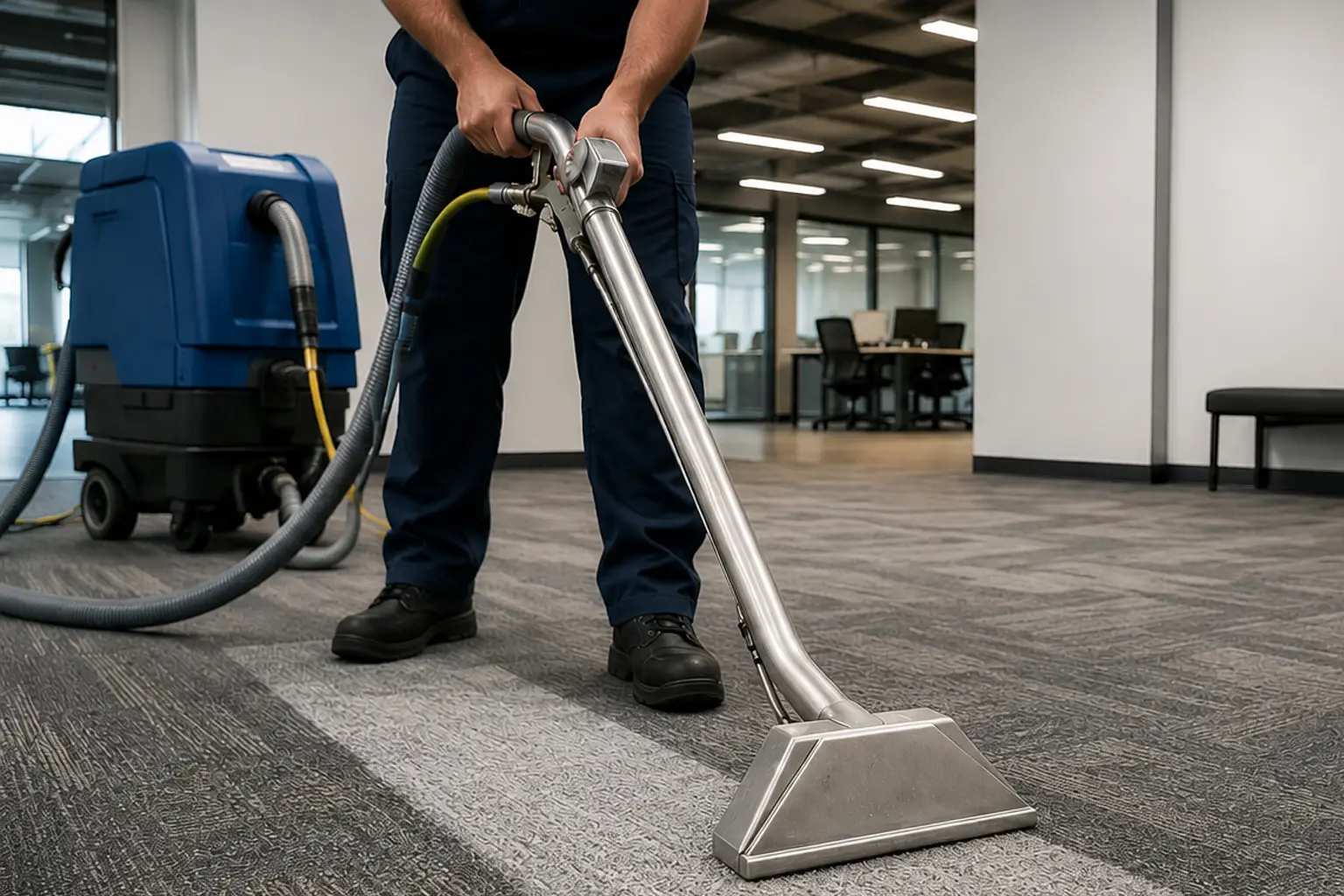
Every carpet cleaning forum has the same argument running on a permanent loop: truck mount or portable. It is the trade's version of Ford versus Chevy, except the wrong answer can cost you $30,000 or cap your business at three jobs a day. The honest answer is that both are right, for different businesses, at different stages, and the operators who get burned are the ones who bought for the business they imagined instead of the jobs on their calendar.
This guide breaks down what the equipment actually costs in 2026, what experienced operators say to buy first, and how the numbers stack up at three startup budgets. Prices below are list or typical street prices at the time of writing and will vary by dealer, package, and promotion.
1. The Truck Mount Question: It Sets Your Ceiling, Not Your Start
Truck-mount hot water extraction is the residential deep-clean standard for a reason: sustained 220 to 250 degree water at the wand, a three-bedroom home in 90 to 120 minutes, four to six jobs a day per truck, and carpet dry in 4 to 6 hours. That last number matters more than new owners think. The franchise giants fight their marketing wars over drying time, because it is the thing customers actually remember.
The cost of entry is real. Entry slide-in units start around $7,500 to $12,000, mid-tier machines run $14,000 to $25,000, and premium units from HydraMaster, Prochem, and Sapphire Scientific push $28,000 to $45,000 before the van. A refurbished Prochem Peak 500 lists around $31,900. And the machine keeps costing money after you buy it: plan on a service every 250 hours at $300 to $600, and $2,500 to $5,000 a year in maintenance once it is working full weeks.
The used market softens the blow. A five-year-old HydraMaster or Prochem typically resells at 40 to 55 percent of original price, and outlets like Used Carpet Cleaning list complete working vans, machine included, for a fraction of a new build. The operator consensus is consistent with every other equipment-heavy trade: do not buy the new truck mount until your calendar proves you need it.
2. Portable Extractors: The $4,000 Business
Most owner-operators start portable, and the good ones are not toys. A Mytee Breeze BZ-105LX runs $3,912 for a 500 PSI pump and dual vacuum motors; entry single-motor units start around $900 to $1,800, and premium heated portables run $2,500 to $5,000. A complete portable startup, machine, wand, hoses, and a used van, is realistic at $4,500 to $8,000 all-in, which is why the 2026 buyer guides peg the portable payback period in days, not months.
The trade-offs are physics: portables lose heat over long hose runs, and the same three-bedroom home takes 2.5 to 4 hours with 8 to 14 hours of drying. But portables also do the work truck mounts physically cannot: high-rise condos above the sixth floor, apartment interiors with no parking, secured office buildings. Established truck-mount companies keep a portable in the fleet for exactly those jobs. It is never wasted money.
3. Wands and Powerheads: Where the Labor Goes
The extractor is half the job; the tool in your hands is the other half. A quality straight wand comes with most packages, but the upgrade operators talk about is rotary extraction. The Rotovac 360i, about $2,495 with a starter kit, replaces hundreds of manual wand strokes with multi-directional cleaning passes, pulls more soil on trashed carpet, and runs on either a portable or a truck mount. On restoration-grade jobs and rental turnovers, it is the difference between fighting the carpet and finishing it.
4. Low-Moisture and Encapsulation: The Commercial Night-Work Play
Commercial carpet is a different business: offices cannot close for a 12-hour dry, so the interim maintenance market runs on low-moisture encapsulation that dries in 30 to 60 minutes. The tool of choice is the counter-rotating brush machine. Whittaker's Smart Care line runs from $2,669 for a 10-inch TWIN to about $5,589 for the 25-inch TRIO encapsulation unit.
The reason to care is the contract structure. Well-run commercial programs alternate recurring encap visits with one or two hot-water restorative cleans a year, which means two price tiers, predictable monthly revenue, and night work that fills the winter trough when residential goes quiet. A CRB machine is not a substitute for your extractor. It is a second product line.
5. The Upsell Kit: Pennies of Chemical, Half the Margin
The gap between a $150 ticket and a $300 ticket is rarely the cleaning. It is protectant at $20 to $50 a room, pet urine treatment at $30 to $75 and up, deodorizer, stairs, and the upholstery tool earning $100 to $200 a sofa while the machine is already running. The equipment for all of it, an upholstery hand tool, a UV flashlight for locating urine deposits, a subsurface extraction tool for saturated pad, and the chemical case, costs less than $1,500 combined, and the chemicals themselves cost pennies per job.
The catch, as every owner eventually complains, is that techs forget to offer any of it when the schedule is tight. The gear is cheap. The system that puts those options on every quote is the hard part, and it is not sold at the supply house.
6. Certification: The $500 That Wins Commercial Bids
The IICRC Carpet Cleaning Technician (CCT) credential is the trade's core certification, a two-day course typically running a few hundred dollars through providers like Jon-Don. It matters for concrete reasons: carpet mills condition fiber warranties on cleaning to the IICRC S100 standard, and healthcare, schools, and facility-management vendor packets ask for it by name. For a startup, it is the cheapest line item on this list with the highest close-rate return on commercial work.
7. Three Startup Budgets That Actually Work
Shoestring, $4,500 to $8,000. A quality portable like the Mytee Breeze, straight wand, hoses, an upholstery tool, a starter chemical case, and a used minivan. Per published breakdowns like DryMaster's, this setup does honest residential work from day one and books apartment and high-rise jobs the truck-mount companies turn down.
Serious hybrid, $12,000 to $20,000. The portable plus a Rotovac powerhead, a Whittaker CRB with encapsulation chemistry, the full upsell kit, CCT certification, and van shelving. This is the tier that can quote residential deep cleans and recurring commercial interim programs, the combination that smooths the January-February trough.
Truck mount, $30,000 to $50,000 and up. A used rig on the low end or a new mid-tier build with the van on the high end. Buy it when the calendar is full and drying time is costing you referrals, not before. The machine raises your ceiling; it does not fill your schedule.
The Wand Does Not Book the Next Job
Everything above buys cleaning capacity. None of it clusters tomorrow's jobs so the truck is not crisscrossing town, puts protectant and pet treatment as priced line items on every estimate, or calls the customer back in 11 months when the carpet is due again, which is the cheapest lead this industry has.
That is software's job. Smart Service is carpet cleaning software built around how the truck actually earns: route-dense scheduling with commercial night work alongside residential day routes, estimates with the add-ons priced in so the upsell is never left to memory, service agreements for the re-clean cycle, and invoicing that closes straight into QuickBooks. If you are pricing out equipment, you are close to launch. Get a free demo and see the operational side before the first job hits the calendar.


