Mission Control
Every tech, job, and mile on one live board — with five assistants that catch conflicts, trim routes, rank openings, forecast the week, and take orders in plain English.
Maintenance Agreements That Renew Themselves, Per-Unit Service Records, and Multi-Visit Installs on One Schedule
Annual and semi-annual maintenance visits generate themselves at each agreement's schedule, with the unit's full record — make, model, serial, transfer switch, and every prior visit — on the tech's phone at the pad. Multi-visit installs run as one job from site survey through startup, inspection and test results get captured on custom forms per unit, and completed work flows straight into QuickBooks.


A standby generator is a fifteen-to-twenty-year relationship disguised as a one-time sale — and the money is in the agreement: one or two scheduled visits a year, per unit, renewing on schedule, with repair and warranty work falling out of the contract base. Smart Service runs that model: agreements that generate their own visits, per-unit records that make every tech the veteran on every account, install projects scheduled across their phases, and billing that follows it all into QuickBooks.
When an outage rolls through, every phone rings at once — no-starts, fault codes, and "it ran for an hour and quit." Smart Service lets dispatch triage the surge with agreement customers prioritized, each unit's history and warranty status on screen, and every repair documented against the unit so the fix — and what it cost — is on the record.

The annual or semi-annual maintenance visit is the business model: oil and filter, battery, plugs, transfer-switch exercise, and a unit that starts when the grid fails. Smart Service generates each agreement's visits at its contracted schedule, keeps the covered units and terms on the record, and fires renewal reminders before expiration — the way operators hit ninety-percent-plus renewal rates.

A standby install is a project: survey and quote, pad and placement, gas line, electrical and transfer switch, inspection, then startup and commissioning — different visits, sometimes different crews or subs, weeks apart. Smart Service schedules the phases as one job so nothing stalls waiting on a visit nobody booked, and the customer sees a company that runs installs like clockwork.

Agreement visits are route work: dozens of units due the same month, scattered across the map. Smart Service clusters due-for-service units geographically into full maintenance days, so the PM season runs dense instead of scattered — and the techs spend their hours at generators, not on the highway between them.

Residential standby runs on homeowner schedules and storm-season demand; commercial and critical-power accounts run on documented test cycles, priority response, and paperwork. Smart Service keeps both on one Dispatch Board with separate rhythms — and gives the commercial side the per-unit test records that facilities working to NFPA 110 expect their service contractor to produce.

Smart Service gives generator dealers and service companies the tools to run maintenance agreements on schedule, keep a complete record on every unit in the field, manage installs across their phases, and close every completed job directly into QuickBooks — from the first site survey through fifteen years of service visits.

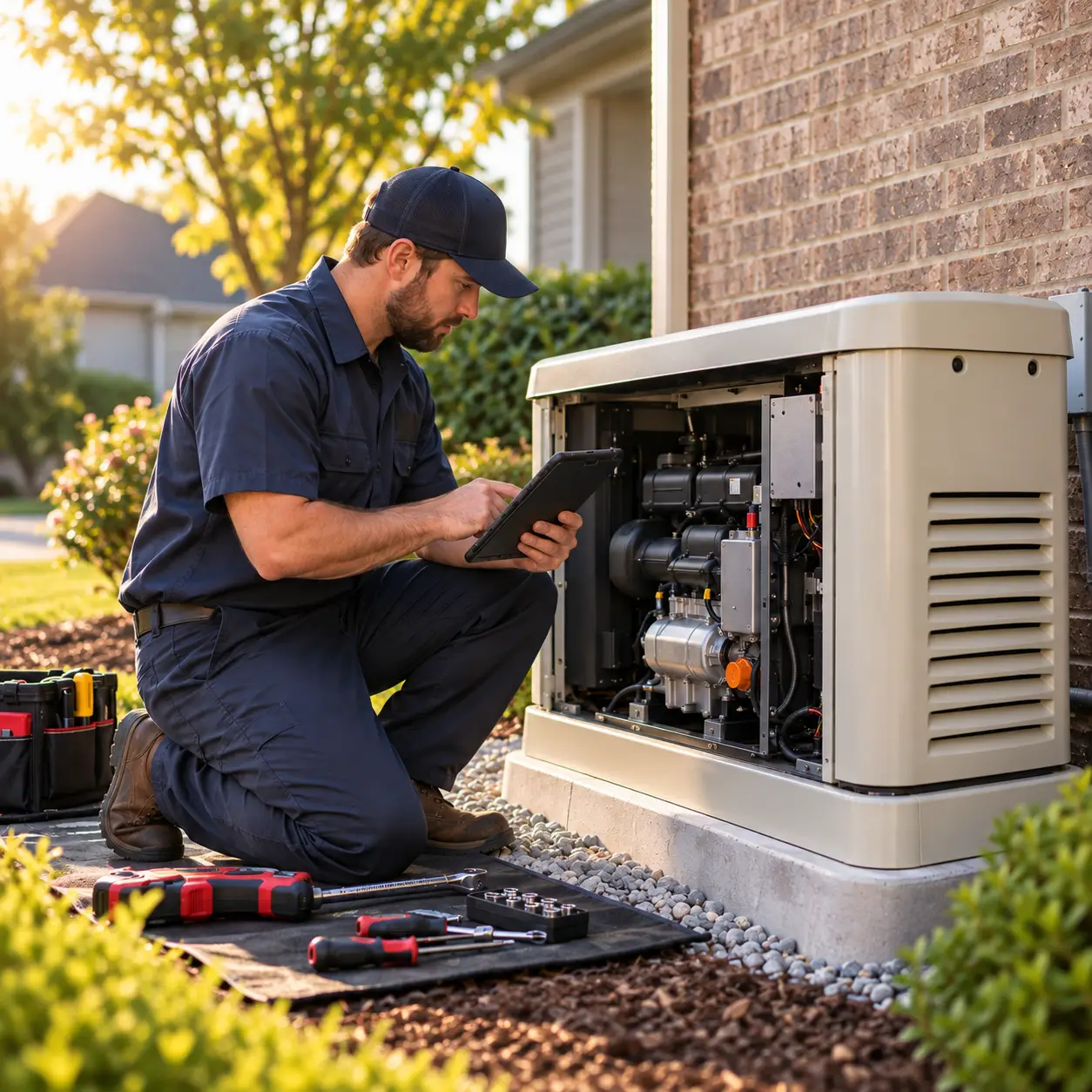
Smart Service builds generator schedules around how the trade actually runs — recurring agreement visits, multi-phase installs, and the outage weeks when everything happens at once.

The Smart Service Cloud mobile app puts the whole unit in the tech's hands — the machine, its history, and the forms the account requires.

Smart Service work orders carry each visit's scope to the field — and capture what was found, done, and recommended before the truck leaves.

Smart Service stores every account's units, agreements, and service history in one record — visible to the office and the field at every visit.

Smart Service is a QuickBooks add-on — not just an integration — connecting scheduling, work orders, and agreements directly to the QuickBooks company file already running the business.
.webp)
The maintenance agreement is the generator business — one or two scheduled visits per unit per year, renewing for the life of a machine that runs fifteen to twenty years — and Smart Service is built to sell, schedule, document, and renew it.
Many generator companies are electrical contractors first — Smart Service handles electrical work too, so service calls, installs, and generator maintenance all run from one schedule.
Generator businesses lose money in three places: maintenance agreements that quietly lapse because renewals ran on memory, unit histories that live in a filing cabinet or an office manager's head, and installs that stall between phases while everyone waits on a visit nobody scheduled.
Smart Service is built to close those gaps: agreements that generate their own visits and renewal reminders, per-unit records on every tech's phone, install phases scheduled as one job, custom forms that capture test and inspection results in the field, and QuickBooks-native invoicing that closes every job without re-entry.
Below are the most common operational challenges generator service businesses face — and how Smart Service addresses each one.
Generator profitability is built on agreement renewals, unit knowledge, and install execution. Manual methods — the renewal spreadsheet, the filing-cabinet unit history, the install phases tracked in someone's head — break down exactly where the recurring revenue lives.
Smart Service automates the full cycle: the install scheduled across its phases, the unit enrolled on an agreement at startup, visits generating on schedule with the unit's record in the tech's hands, results captured in the field, invoices into QuickBooks, and renewals firing before the lapse.
Smart Service's integrated CRM keeps every generator account's units, agreements, documentation, and billing history in one place — the institutional memory of a fifteen-year service relationship, surviving every staffing change along the way.
Track per-unit details, manage maintenance agreements, handle mixed residential and commercial billing, and automate renewals and reminders from one platform that runs the schedule too.


Generator customers come in three shapes: homeowners who want to know their unit will start, property and facility managers who want documentation more than conversation, and commercial accounts tracking service against a contract. Smart Service's portal serves each one.

Revolutionize Your Workflow with the Smart Service Customer Portal – Convenience, Efficiency, and Loyalty at Your Fingertips
Generator businesses run on agreement renewal rate, revenue per tech-day, and install margin — the numbers that decide what the business is worth. Smart Service's Dashboards turn completed work into live reporting on contract retention, PM completion, and repair attach on the agreement base, so growth decisions run on evidence.
The dashboards read live from the same system running scheduling, agreements, and invoicing — no exports, no spreadsheet archaeology.
In Smart Service Cloud, The Oracle sits on top of these dashboards: ask a question in plain English — “Which job types lost money last quarter?” — and get the chart plus a plain-language takeaway you can save and rerun on live data.
.webp)

Smart Service gives you the tools to automate your workflow, improve operational efficiency, and deliver an exceptional customer experience. With real-time scheduling, customer management, and invoicing solutions, you can eliminate inefficiencies and focus on what truly matters—growing your business.
Yes — Smart Service is a QuickBooks add-on, not just an integration. Install invoices, maintenance agreement billing on its contracted schedule, and repair tickets all flow from completed work orders into the QuickBooks company file already running your business, with no double entry. Residential per-visit billing and commercial contract billing on terms run through the same workflow.
Yes. Every unit gets its own record — make, model, serial number, fuel type, transfer switch, install date, warranty status — with every maintenance visit, test result, repair, part, and photo attached to it. Techs see the whole history on the mobile app before the cover comes off, and inspection and test results captured on custom forms are stored per unit, retrievable whenever a facility manager, insurer, or inspector asks.
That's the core of it. Agreements hold each account's covered units, visit schedule, and terms; the annual or semi-annual maintenance visits generate themselves onto the Dispatch Board at the contracted cycle; and automated renewal reminders go out ahead of every expiration — so the recurring contract base the business is built on renews by process instead of memory.
Yes, Smart Service allows you to send automated notifications and reminders to customers, keeping them informed about upcoming appointments, job statuses, and invoices, improving overall customer satisfaction.
Yes! The Smart Service mobile app gives your technicians real-time access to job details, schedules, and invoicing on the go. This allows them to stay connected and complete jobs more efficiently, reducing paperwork and delays.
Smart Service streamlines the invoicing process by allowing you to generate invoices from both the office and the field. Integrated payment processing helps you get paid faster, improving cash flow and reducing billing cycles.
Yes, Smart Service seamlessly integrates with QuickBooks™, allowing you to sync products, services, and invoices in real time. This eliminates double data entry and helps streamline your bookkeeping, ensuring accurate invoicing and faster payments.
Yes, by automating key processes like scheduling, invoicing, and job management, Smart Service reduces manual administrative tasks, freeing up time for you to focus on growing your business.
Yes, Smart Service makes it easy to schedule and manage recurring jobs. You can automate recurring appointments, ensuring that no jobs fall through the cracks.
Yes, Smart Service allows you to automate recurring maintenance jobs, ensuring that they are scheduled on time and never missed.
Yes, Smart Service’s mobile app allows technicians to create and send invoices directly from the job site, ensuring faster payments and eliminating delays.
Absolutely. Smart Service centralizes all customer data, including service histories, equipment details, and invoices, making it easier to manage customer relationships and improve customer satisfaction.
Yes, Smart Service’s mobile app allows technicians to add parts, update job details, and submit work orders directly from the field, ensuring real-time updates and accuracy.
Yes, with Smart Service’s Customer Portal, your customers can book online, view service histories, and make payments—making the process more convenient for both you and your clients.
Yes, Smart Service provides real-time updates on technician performance and job completion, helping you monitor productivity and improve operations.