


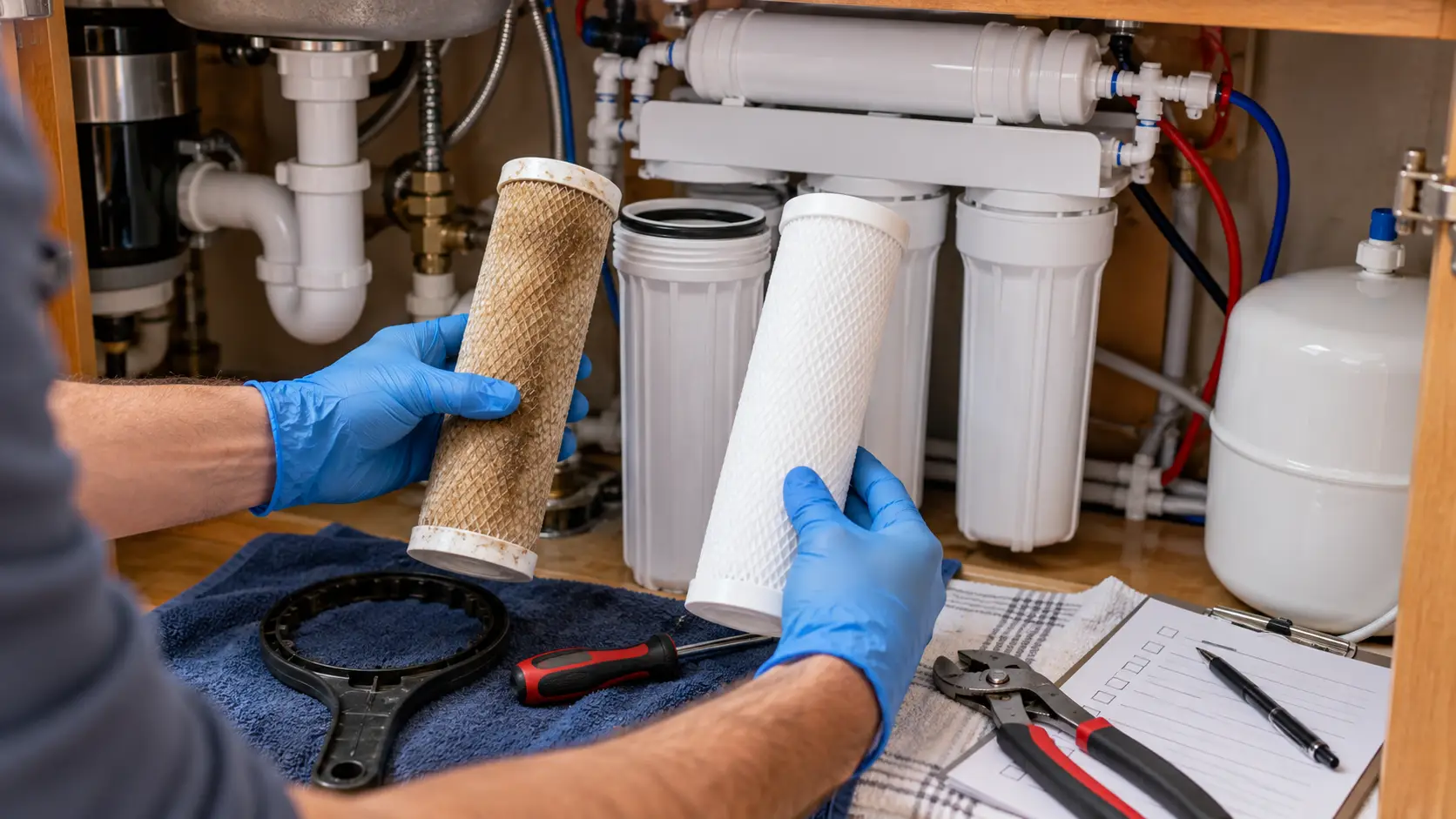
A water softener is one of the lowest-maintenance appliances in the house — which is exactly how it ends up neglected. Low maintenance is not no maintenance: the salt still has to be refilled, the filters and membranes upstream and downstream of it still age out on their own schedules, and the system that quietly protected your water heater for a decade will quietly stop doing it if nobody checks. This guide lays out the real service schedule — for softeners, whole-house filtration, and reverse osmosis systems — whether you handle it yourself or your water treatment company handles it for you.
What Maintenance Does a Water Softener Actually Need?
A water softener needs four things: salt kept topped up, a periodic check that it's actually regenerating, an annual inspection and brine tank cleaning, and — every decade or so — an honest look at whether the resin bed is done. Between those, it runs itself. The trouble is that three of the four are easy to forget precisely because the softener asks for so little: soft water fails gradually, not suddenly, and most households don't notice the spots on the glassware until the resin has been working unprotected for months. The Water Quality Association's softener guidance is a solid baseline for what a properly running system should look like.
How Often Should You Add Salt to a Water Softener?
Check the brine tank monthly and expect to add salt every six to eight weeks for a typical household — more often with very hard water or a big family, less with efficient demand-initiated units. Two rules of thumb: keep the tank at least a quarter to half full, and keep the salt level a few inches above the water line. While you're in there, look for a salt bridge — a hard crust that forms above the water so the tank looks full while the softener regenerates with plain water below it. If the salt doesn't shift when you push on it with a broom handle, break it up. A softener with a salt bridge is a softener that isn't softening.
How Often Should Whole-House Filters and RO Membranes Be Changed?
Sediment and carbon filters run six to twelve months; reverse osmosis pre- and post-filters run six to twelve months; RO membranes run two to five years; UV lamps get replaced annually whether they look spent or not. The exact interval depends on your water — heavy sediment or iron shortens filter life, and a membrane behind well-maintained prefilters lasts years longer than one behind clogged ones. Two signals it's overdue: pressure drop at the fixtures (filters loading up) and RO water that starts tasting like tap water (membrane or post-filter aging out). Write the change dates on the housings — or better, keep them in a service record, which is exactly what a professional maintenance plan does.
What's on a Professional Water Softener Maintenance Checklist?
A professional annual visit covers what the monthly salt check can't:
- Water test, before and after — hardness, iron, and TDS at the tap, compared against the system's targets and last year's numbers.
- Regeneration cycle check — watching the unit actually run a cycle: timing, brine draw, and rinse.
- Brine tank cleaning — sludge and salt mushing removed before they foul the injector.
- Valve, seals, and bypass inspection — the wear parts that fail at 2am, checked in daylight.
- Filter and membrane changes — everything due on the schedule, swapped and logged with dates.
- Settings review — hardness setting and regeneration frequency matched to current water conditions and household size.
The checklist matters less than the record: a system with a documented history of tests and changes is a system whose problems get caught as trends, not as floods.
Should You Maintain It Yourself or Get on a Service Plan?
Salt is a homeowner job; the annual visit is worth paying for. The economics are simple: a maintenance plan costs a fraction of a resin bed replacement, and the annual water test is how you find out the softener stopped protecting the water heater before the water heater finds out. Dealers structure plans around exactly the schedule above — the salt deliveries, the filter changes on their intervals, the annual test and inspection — which is also why the plan customer's system outlives the neglected one by years.
For Water Treatment Companies: Running This Schedule at Scale
Everything above is one house. A water treatment dealer runs this schedule across hundreds or thousands of installed units — each with its own filter intervals, salt appetite, membrane age, and test history — and the reminder file that works for one home fails completely at that scale. That's the problem water treatment software exists to solve: every unit's record generates its own service schedule, due filter changes and salt deliveries become optimized routes, test results get captured against the property, and completed visits bill through QuickBooks automatically. Smart Service's service agreement tools run the whole maintenance-plan cycle — the visits, the renewals, the recurring billing — and if your contract book currently lives in a spreadsheet, see a demo before the next round of filter changes comes due.


