


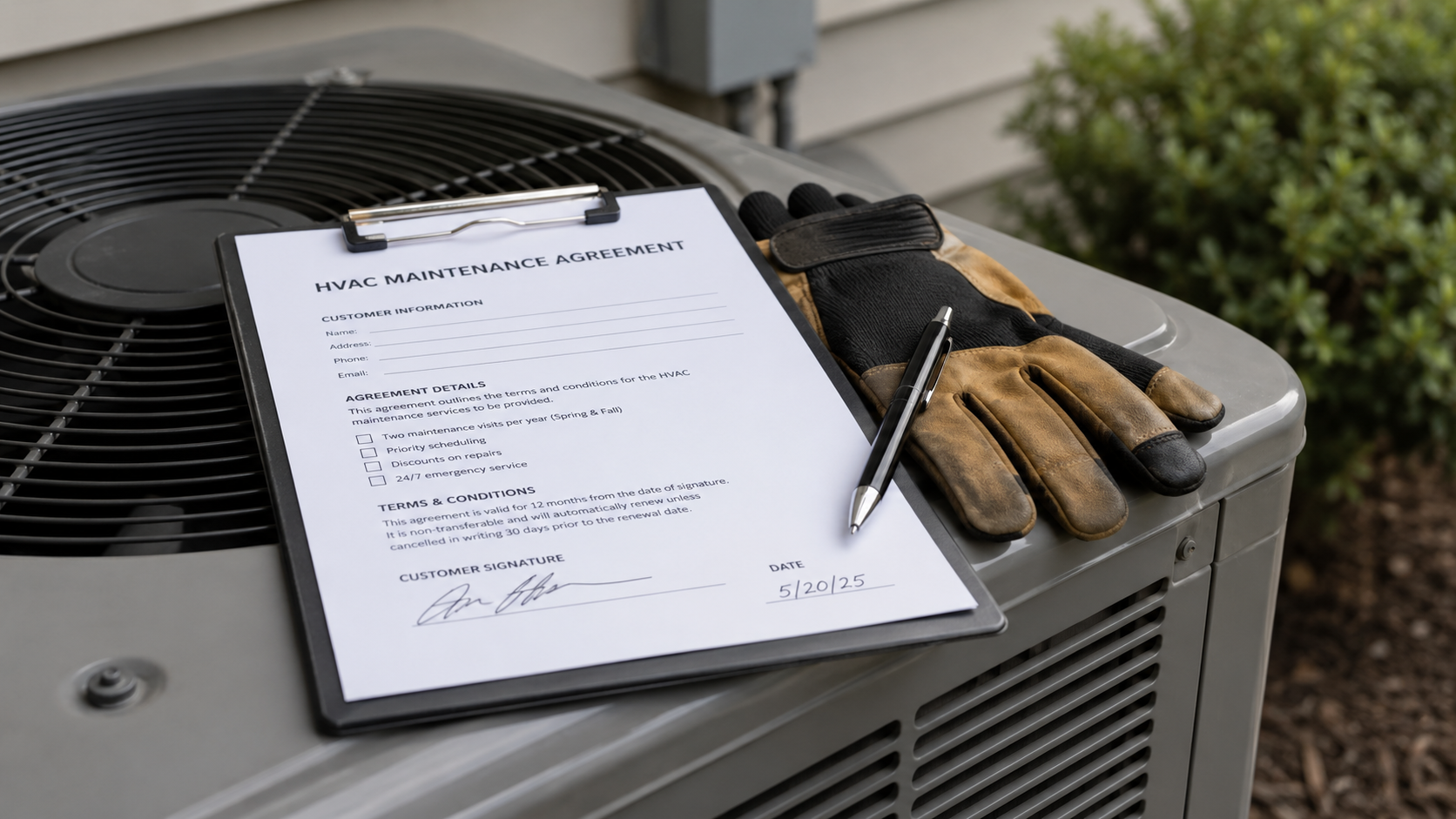
Most HVAC service agreements don't fail on price — they fail on paperwork. A homeowner agrees to a maintenance plan at the kitchen table, the office never gets the terms in writing, and eighteen months later nobody can say what the plan covers, when it renews, or whether that compressor repair was supposed to be discounted. The fix is a contract with the right sections in it, used the same way on every sale. This guide walks through each section an HVAC service agreement needs, gives you a copy-ready template outline, and flags the mistakes that quietly kill renewal rates. (If you're still deciding whether to offer agreements at all, start with the case for HVAC service agreements; for what to charge, see how much to charge for HVAC service agreements — this guide covers the document itself.)
Section by Section: What the Agreement Needs
1. Parties and covered property. The customer's legal name, the service address, and — critically — an equipment schedule: each covered unit listed by type, make, model, serial number, and install date. "The HVAC system" is a dispute waiting to happen at any home with two condensers or a property with a mix of old and new equipment. The equipment schedule is what turns coverage arguments into a thirty-second lookup.
2. Scope of service per visit. Spell out exactly what a maintenance visit includes: inspection points, filter replacement, coil cleaning, refrigerant-level check, electrical-connection verification, condensate drain treatment — whatever your tune-up actually covers. The industry has a real reference here: ACCA Standard 4 defines minimum maintenance tasks and frequencies for residential systems, and ACCA's own guidance on maintenance plans is a useful benchmark for whether your checklist would hold up next to a competitor's. A scope section that mirrors a recognized standard also gives your techs a defensible answer when a customer asks why something isn't included.
3. Visit frequency and scheduling terms. Two visits per year is the residential default (cooling season and heating season); quarterly is common for light commercial. State who initiates scheduling — the strongest agreements say the company schedules proactively, because plans that depend on the customer calling in are plans that quietly go unused and then don't renew.
4. Term and renewal. Start date, initial term (usually one year), and what happens at the end of it. Auto-renewal with clear notice is the industry norm because it works — manual re-signing roughly halves renewal rates — but auto-renewal language is regulated differently from state to state, so have your attorney review the renewal and cancellation clauses before you print five hundred copies.
5. Price and payment terms. The annual or monthly price, what it covers, accepted payment methods, and — easy to forget — a price-escalation clause permitting reasonable annual increases at renewal. Plans without one end up underwater by year three. The actual number is its own topic: our agreement pricing guide covers benchmarks and cost-buildup math.
6. Member benefits. Priority scheduling, discounted repair labor, waived or reduced diagnostic fees, extended workmanship warranties — whatever your plan includes beyond the visits. Write each benefit as a specific, checkable claim ("15% off repair labor") rather than a vague promise ("preferred pricing").
7. Exclusions and limitations. The section that prevents the worst arguments. Typical exclusions: repair parts (on basic tiers), refrigerant beyond a stated allowance, code-required upgrades, damage from power surges or acts of nature, and systems modified by others. If you enroll older systems, state any age-related limits here instead of arguing about them at a breakdown.
8. Cancellation, liability, and signatures. How either party exits (notice period, any proration), your workmanship warranty terms, limitation of liability, and signature lines with dates. Unsigned agreements are worth exactly what they cost to print.
Copy-Ready Template Outline
Here's the skeleton to hand your attorney — every numbered item above, in contract order:
- 1. Parties & Covered Property — customer, service address, equipment schedule (type / make / model / serial / install date per unit)
- 2. Scope of Service — itemized per-visit checklist, by season
- 3. Visit Schedule — frequency, seasons, who schedules
- 4. Term & Renewal — start date, initial term, renewal mechanics, notice
- 5. Price & Payment — amount, billing cadence, escalation clause
- 6. Member Benefits — priority service, discounts, waived fees, stated specifically
- 7. Exclusions & Limitations — parts, refrigerant allowance, age limits, third-party damage
- 8. Cancellation & Liability — exit terms, warranty, liability limits
- 9. Signatures & Date
Residential vs. Commercial Differences
The residential template above stretches to light commercial with a few additions: a per-unit maintenance schedule (a rooftop package unit and a split system in the same building need different checklists), net-30 payment terms in the price section, certificate-of-insurance language, and — for multi-location accounts — an exhibit listing each covered site with its own equipment schedule. Heavy commercial work usually starts from the customer's contract instead, but the same nine sections are the checklist for what yours must protect.
Four Mistakes That Kill Renewals
No equipment schedule. Coverage disputes on multi-system properties end relationships. No auto-renewal mechanics. Plans that lapse silently don't come back. Vague benefits. "Preferred customer treatment" creates expectations you can't systematically deliver; "repairs scheduled within 24 hours" is a promise your dispatch board can actually keep. No escalation clause. Locking 2026 pricing into a plan that renews untouched for five years turns your best customers into your least profitable ones.
From Template to Running Program
The document is the easy half. The operational half — generating each covered visit on schedule, surfacing renewals before they lapse, applying member discounts on repair invoices, and billing the plan without double entry — is where spreadsheets give out somewhere around fifty active agreements. That's the job of service agreement software: every agreement's terms, equipment schedule, visit cadence, and renewal date drive the schedule and the billing automatically. For the wider tooling picture, see how HVAC software handles service agreements and how to boost agreement sales.
Smart Service for HVAC
If you're running an HVAC business and want the agreements in this template to schedule, renew, and bill themselves, Smart Service's HVAC dispatch software integrates with QuickBooks and keeps your techs and office in sync through the Cloud mobile app — every covered visit generated on time, every renewal surfaced before it lapses. Try a free demo to see how it fits!


