


The fuel card statement shows up once a month. One number at the bottom. And it's bigger than last month.
So somebody asks why, and somebody gives the answer everybody gives: gas went up.
Maybe. Or maybe your trucks drove more miles. Or maybe one van is burning a lot more than the others and nobody has noticed, because it's buried in the total. Those are three different problems with three different fixes, and the number at the bottom of the statement can't tell you which one you have.
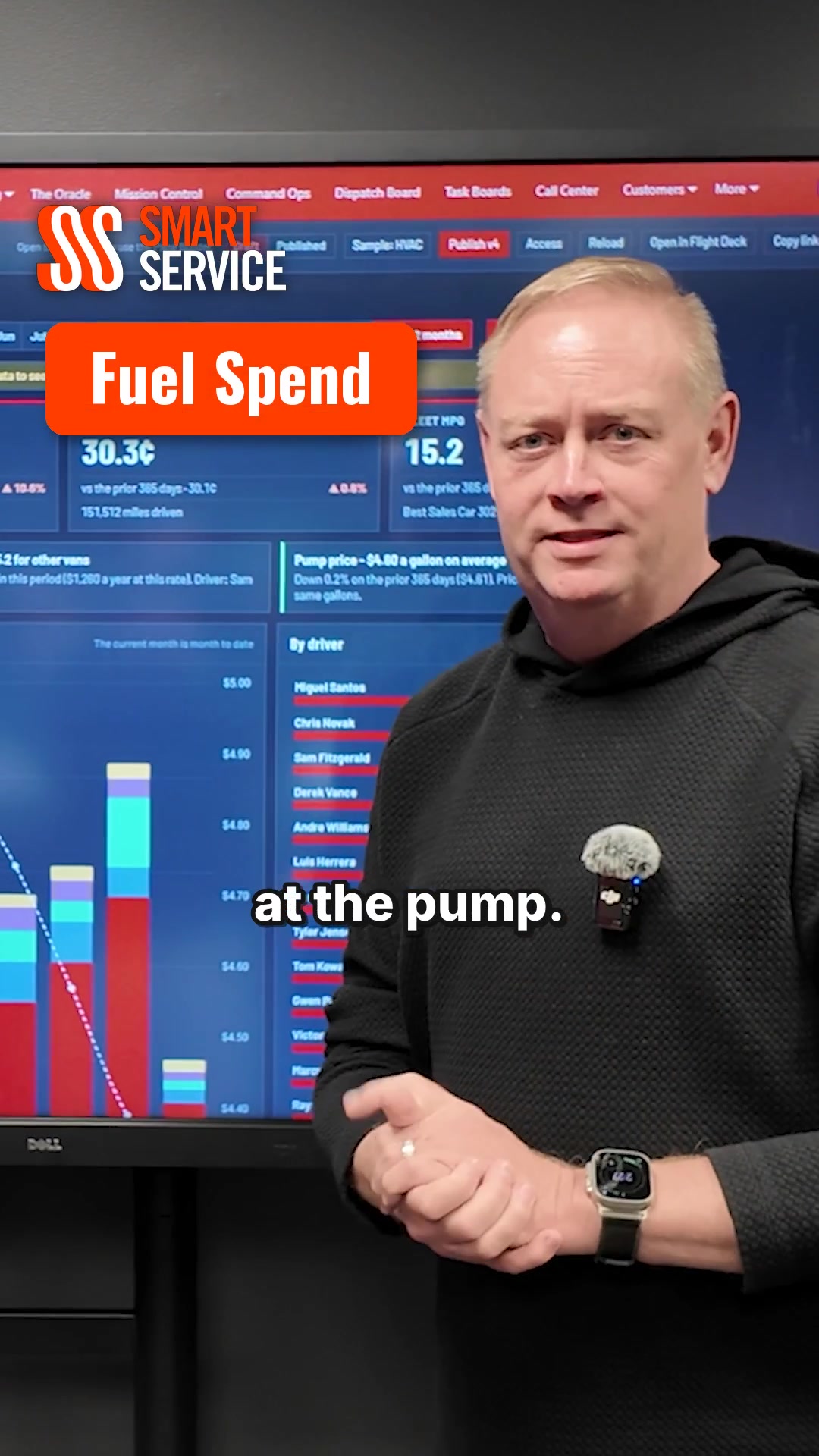
In the video below, Skip Stringfield, founder of Smart Service, walks through the Fuel Spend board.
Three reasons a fuel bill goes up
A fuel bill is simple arithmetic. It's the gallons you bought, times the price you paid for each one. And the gallons come from two things: how many miles you drove, and how many miles each vehicle gets out of a gallon.
So only three things can move the bill:
- The price at the pump
- The miles your fleet drove
- The miles per gallon your vehicles are getting
Each one has its own fix. You can't fix the price. You can only plan for it. Miles are a routing question, and we covered that in how to manage high fuel costs. Miles per gallon is a truck that needs a shop visit, or a driver who needs a conversation.
The mistake is treating all three as one problem called "fuel."
Start with gallons, not dollars
Here is the fastest way to sort it out. Look at gallons before you look at dollars.
If the dollars are up and the gallons are flat, it's the price. If the gallons are up, it's you.
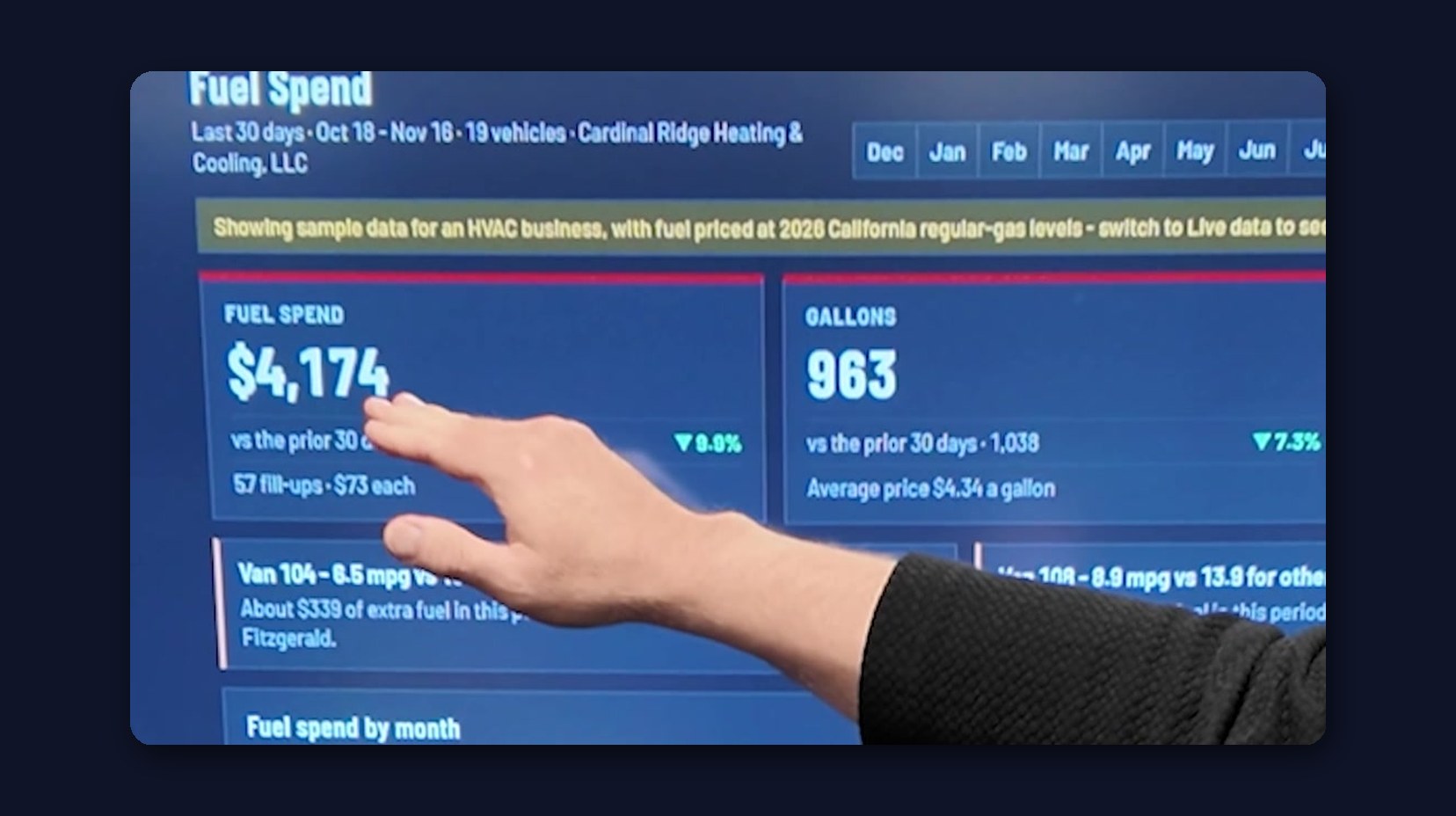
On the board in Skip's video, an HVAC company spent $4,174 on fuel in 30 days. It bought 963 gallons, down from 1,038 the month before. That's 7.3% fewer gallons, at an average of $4.34 each.
So this was a good month. Fewer gallons, and a smaller bill than the month before.
That is exactly when nobody looks any closer. And it's the wrong time to stop, because a total can go down while one vehicle inside it goes the other way.
Compare each vehicle with the others like it
A fleet average hides the problem. On that same board the fleet gets 14.2 miles per gallon. The best vehicle is a sales car getting 47.8 and the worst is a van getting 6.5. Those two were never going to match.
The useful comparison is like against like. Vans against vans. Box trucks against box trucks.
Do that, and one van stands out. Van 104 is getting 6.5 miles per gallon while the other vans get 13.9. That's about $339 of extra fuel in 30 days, or $4,128 a year at that rate.
One van. About $4,100 a year. In a month when the total went down, so nobody had a reason to ask.
One bad tank or ten in a row
Once you know which vehicle, look at it month by month. In Skip's video, van 104 went from $390 of fuel in September to $763 in October. Nothing else on the board moved like that.
Then look at its fill-ups one at a time: the date, the driver, the odometer, the gallons, the amount, and the miles per gallon on that one tank.
One bad tank is a mistake at the pump. Ten bad tanks in a row is a mechanical problem. You can't tell which one you have from a monthly total. You can tell in about ten seconds from a list of fill-ups.
Know your cost per mile
Cost per mile is fuel dollars divided by miles driven. On the board, that's $4,174 over 13,675 miles, or 30.5 cents a mile, down from 32.8.
It's the one fuel number that stays honest when you get busier. A bigger bill in a bigger month is fine. A higher cost per mile is not, because it means every mile you drive is costing more than it used to.
What to write down at every fill-up
None of this works without the fill-ups. For each one, you need six things:
- Which vehicle
- Who filled it
- The date
- The odometer reading
- The gallons
- The dollars
The odometer is the one people skip, and it's the one that matters. Without it there are no miles, and without miles there is no miles per gallon and no cost per mile. You're back to one number at the bottom of a statement.
How Smart Service shows it
Fuel Spend is one screen in Smart Service that adds up every fill-up by vehicle and by driver.
Across the top are four numbers: fuel spend, gallons, cost per mile and fleet mpg, each one against the period before. Under those, the page says what it found in plain words, like a van getting 6.5 miles per gallon against 13.9 for the other vans, what that cost, and who drives it. Another card tells you what the pump price did.
Below that is fuel spend by month, stacked by kind of vehicle, with price per gallon as a dashed line. When the bars climb and the line doesn't, you know where to look. There's a list by driver, and a table by vehicle, month by month. Tap a vehicle and you get every fill-up. Switch between the last 30 days, the last 90 days and the last 12 months.
So the next time somebody asks why fuel is up, you don't say "gas went up" and hope. You say it was the price, or it was the miles, or it was that one van. And you say what you're doing about it.
If you want to see Fuel Spend with your own trucks on it, book a demo.
FAQ
How do I calculate fuel cost per mile?
Divide what you spent on fuel by the miles you drove in the same period. $4,174 of fuel over 13,675 miles is 30.5 cents a mile. Track it every month so you can see it move.
How do I know if a truck is using too much fuel?
Compare it with the other vehicles of the same kind, not with the fleet average. A van getting 6.5 miles per gallon when your other vans get 13.9 is a van to look at.
What should I track at every fill-up?
The vehicle, the driver, the date, the odometer reading, the gallons and the dollars. The odometer is what turns a receipt into miles per gallon.
Is a higher fuel bill always a problem?
No. If you drove more miles because you did more work, a bigger bill is what you should expect. Check cost per mile and miles per gallon. If those held steady, the bill is just the cost of a busy month.


