


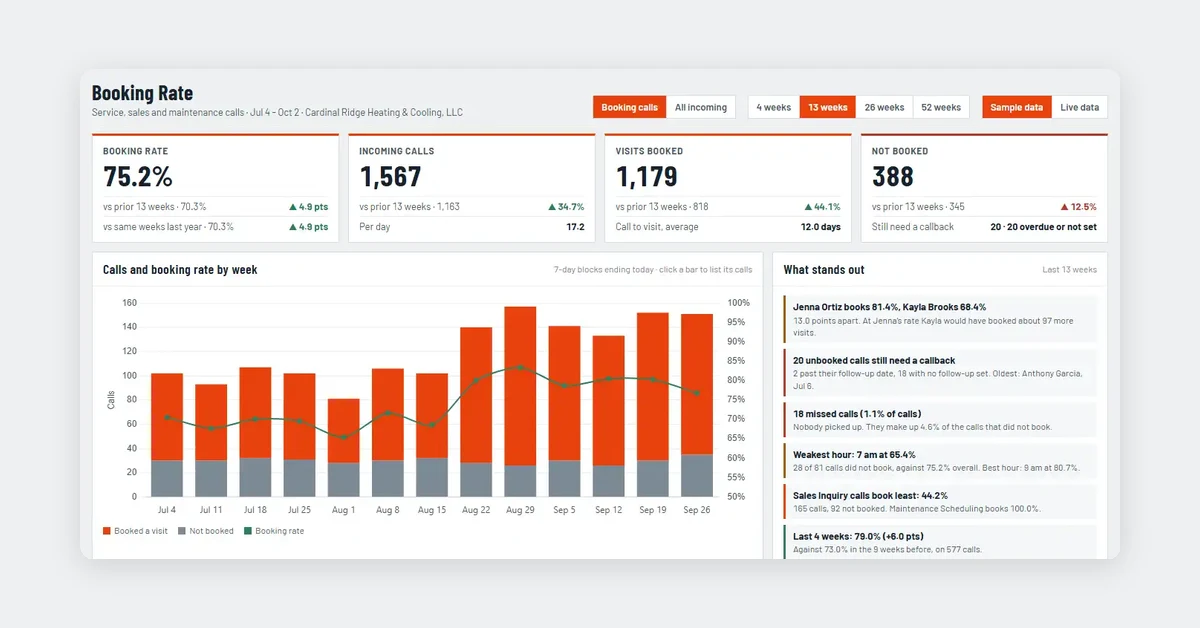
The phone rang 1,550 times last quarter. 377 of those calls never turned into a job.
Do you know which ones?
Most owners can tell you their revenue to the dollar and can't tell you their booking rate within ten points. That's backwards. Revenue is what already happened. Booking rate is what's about to happen. It's the number that decides whether the money you spent making the phone ring turned into trucks rolling.
In the video below, Skip Stringfield, founder of Smart Service, walks through a real booking rate board in under three minutes.
What Booking Rate Is
Booking rate is simple arithmetic: visits booked, divided by incoming calls, as a percentage.
Take 1,550 incoming calls. Book 1,173 visits. That's a 75.7% booking rate. The other 377 calls, a quarter of everything that came in, ended without a job on the calendar.
That's the whole formula. The reason most companies don't know their number isn't that it's hard to calculate. It's that nobody is counting the calls. The phone system counts rings. The schedule counts jobs. Nothing in between counts the calls that came in and left without booking, and those are the ones that cost you.
What a Good Booking Rate Looks Like
On the board in Skip's video, a sample HVAC company is running 75.7% over the last 13 weeks, up 6.8 points on the 13 weeks before that and up 3.8 points on the same weeks last year. The last four weeks ran 78.8% against 73.9% in the nine weeks before. That's a company getting better at the phones, and able to prove it.
The honest answer to "what's a good booking rate" is: higher than yours was last quarter, and you can only say that if you measured last quarter. But here's the math that makes the number matter. At 1,550 calls a quarter, one percentage point of booking rate is about 15 jobs. Five points is 77 jobs. You don't have to buy a single extra lead to get them. The calls already happened. You paid for them. You just didn't book them.
Two things move the number more than anything else, and both of them are hiding in plain sight.
The Person on the Phone Matters More Than the Ad Spend
On Skip's board, one customer service rep (CSR) books 81.5% of her calls. Another books 69.3%. Same phones, same callers, same offers. If the second one had booked at the first one's rate, the company would have had 91 more jobs over those 13 weeks.
Ninety-one jobs. Not from a new campaign or a price change. From the difference between two people answering the same phone.
You can't coach that gap if you can't see it, and you can't see it unless booking rate is tracked by person. Once it is, the conversation stops being "I think Kayla's doing fine" and becomes "Kayla, you're at 69 and Jenna's at 81, let's listen to a few of your calls together." That's CSR training that actually changes a number.
Your Worst Hour Is Probably Hiding
Booking rate isn't flat across the day. On Skip's board the weakest hour is 4 PM at 67.3%: 48 of 147 calls in that hour didn't book. Every other hour runs higher.
Nobody noticed, because nobody counts calls by the hour. Once you do, the fix is usually a schedule, not a hire: who's on the phones at 4, who left at 3:30, who's covering while the dispatcher builds tomorrow's board. A big gap between your best hour and your worst hour is a staffing problem with a known fix. You just need the number.
The Calls That Didn't Book Aren't Gone Yet
A call that didn't book today isn't a lost job. It's a lead with no follow-up on it.
Skip's board shows 27 unbooked calls still waiting on a callback. Five are past due. Twenty-one have no follow-up set at all. That's 21 people who called, didn't book, and won't get a call back, because nobody wrote it down.
Then there are the missed calls, 21 of them, 1.4% of the total, where nobody picked up. Those callers are on the phone with the next company on the list.
Every one of these is recoverable if somebody can see the list. None of them is recoverable from memory. (If the bigger problem is getting calls onto the calendar in the first place, see how HVAC booking software closes the gap between the call and the truck.)
How Smart Service Tracks It
The Booking Rate page in Smart Service does the counting so nobody has to. At the top: booking rate, incoming calls, visits booked, and not booked, each compared against the prior 13 weeks and the same weeks last year. Below that, calls and booking rate by week, so you see the trend instead of guessing at it.
Then the part that does the thinking for you. A "What stands out" panel reads the board and tells you in plain sentences which CSR books at what rate and how many visits the gap cost, how many unbooked calls still need a callback and which are past due, how many calls were missed, which hour is weakest and which is best, and which call types book least. Under that sits booking rate by person and by hour of day, and you can click a row to see the calls behind it.
Switch between 4, 13, 26, or 52 weeks and every number on the page follows. And if you want a column added or a tile changed, you ask for it in plain English.
Skip's line at the end of the video is the right one: booking rate is the number one metric you need to know at all times. Not because it's the biggest number in the business, but because it's the earliest one. By the time it shows up in revenue, the quarter's over.
Frequently Asked Questions
How do I calculate booking rate?
Visits booked divided by incoming calls, times 100. If 200 calls came in and 150 became scheduled visits, your booking rate is 75%. Count every incoming call, not just the ones that reached a person. The missed calls are part of the total.
What is a good booking rate for a field service company?
There's no universal number, because the call mix changes it: maintenance-scheduling calls book close to 100% while sales inquiries book under half. What matters is your own trend, and the gap between your best and worst CSR and your best and worst hour. If either gap is more than ten points, you have jobs to recover before you need more leads.
How do I improve my booking rate without hiring?
Track it by person and by hour first. Most companies find one CSR well below the others and one hour of the day well below the rest, and both have schedule-and-coaching fixes. Then work the unbooked list: every call that didn't book gets a follow-up with a name and a date on it.
See Your Own Booking Rate
If you can't name your booking rate within five points, start there. Smart Service is field service software built for HVAC and every other trade, it integrates with QuickBooks, and it keeps the office and the trucks on the same screen. Book a free demo and we'll show you the Booking Rate page with your own calls on it.


