


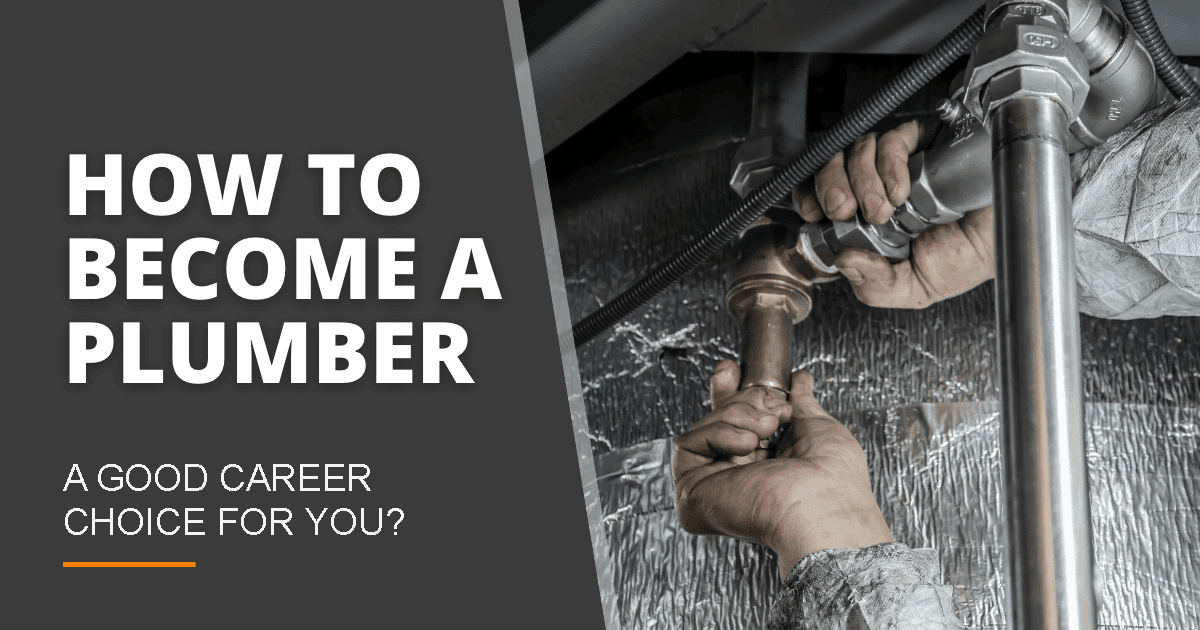
Plumbing remains one of the most stable, best-paying skilled trades in America, and demand has not slowed. If you enjoy working with your hands, solving real problems, and want a career that cannot be outsourced or automated, becoming a plumber is a great move. Here is exactly how to do it.
Plumbers install and repair the pipes, fixtures, and systems that move water, gas, and waste through homes and businesses. Most plumbers work full time, and many work more than 40 hours a week. Emergency calls in the evenings and on weekends are common. Some plumbers work for established companies as employees, others work as independent contractors, and many eventually run their own businesses.
If you are considering plumbing as a career, this guide walks through whether it is a good fit, how long it takes, what it pays, what schooling costs, and the career path from apprentice to master plumber.
Is Plumbing a Good Career?

Plumbing is a strong career fit if you enjoy working with your hands, have good problem-solving and communication skills, and can follow instructions while paying close attention to detail. The trade rewards people who show up on time, do quality work, and treat customers well. The earning ceiling is high if you build the right reputation.
What Does a Plumber Do?
Most plumbers work in the construction industry, though some work in residential service or in the maintenance department of a factory or commercial facility. Plumbers install and repair pipes and fixtures (toilets, sinks, tubs, dishwashers, water heaters), as well as gas lines, sewer systems, and the rough-in plumbing on new construction.
The work can be physically demanding. Plumbers often work in cramped or uncomfortable positions, lift heavy materials, and operate in a wide range of weather conditions on outdoor or new-construction job sites. Safety training matters.
How Much Does a Plumber Make?
According to the U.S. Bureau of Labor Statistics, the median annual wage for plumbers, pipefitters, and steamfitters was $62,970 in May 2024. The lowest 10% of plumbers earn under $40,000 a year, while the top 10% earn more than $105,150. Pay varies based on experience, geographic region, union membership, specialty such as gas, hydronic, or commercial, and whether you work as an employee or run your own business.
Plumbers who own their own businesses can scale earnings well into six figures depending on the size of their customer base, their service area, and the contracts they win. For a deeper dive, see how much a plumber makes.
What Is the Plumber's Job Outlook?
The BLS projects employment of plumbers, pipefitters, and steamfitters to grow 4% from 2024 to 2034, about as fast as the average for all occupations. About 44,000 openings for plumbers are projected each year on average over the decade, driven by the need to replace plumbers who retire or move to other occupations.
The job market is strong because the work cannot be outsourced or automated, and a wave of retirements among older plumbers is creating openings faster than younger workers are entering the trade. New construction and infrastructure spending also continue to keep demand high in most metros.
How Long Does It Take to Become a Plumber?
Generally, four to five years of schooling and apprenticeship to become a licensed plumber. The exact timeline depends on your previous work experience, the type of training program you enter, and the licensing requirements in your state. That timeline is roughly the median for skilled trade professions.
How to Become a Plumber
You can become a plumber by following these four steps:
- Get a high school diploma or equivalent. Although not required everywhere, completing a vocational program or taking classes in plumbing, math, and basic shop will give you a real edge in the apprentice job market.
- Complete an apprenticeship program. Apprenticeships typically last four to five years and combine paid on-the-job training with classroom instruction. Most apprentices put in roughly 2,000 hours of supervised work each year.
- Get a plumbing license. Most states require a license before you can work independently. Licensing requires passing an exam covering plumbing code, safety, and hands-on competency.
- Join a professional organization. Membership in groups like the American Society of Plumbing Engineers (ASPE) or the Plumbing-Heating-Cooling Contractors Association (PHCC) gives you networking, resources, and continuing education.
Plumber Education Requirements

To become a plumber, you need to complete an accredited training program. Attending an accredited school ensures you receive quality instruction and that future employers will recognize your credential.
The most common path is a four-year apprenticeship that includes around 2,000 hours of on-the-job training each year, working under the supervision of a licensed plumber. Once you complete your apprenticeship, you take your state's licensure exam to become a journeyman plumber. After several more years on the job, you can take the master plumber exam (a written and practical test) to qualify for the top tier of licensing.
How Much Does Plumbing School Cost?
The cost of plumbing training in the United States varies based on the school, format, and program length:
- Online plumbing diplomas typically cost between $900 and $1,200 in total.
- Apprenticeship programs are often free or low-cost to the apprentice, since you are paid while you train. Some union and JATC programs cost a few hundred dollars in registration and book fees per year.
- Certificate and diploma programs at technical and trade schools usually last one to two years and cost roughly $1,500 to $15,000 depending on the school.
- Associate degree programs at community colleges typically run two years and cost between $4,000 and $25,000 total depending on residency.
- Tools and books generally add about $1,500 to $2,500 over the course of training, plus state licensing fees of around $100-$400.
How Affordable Are Plumbing Schools Compared to a Traditional University?
Plumbing training is dramatically cheaper than a traditional four-year university. Average tuition and fees at a public, four-year, in-state college were $11,950 for the 2025-26 academic year, and the full average cost of attendance (tuition, fees, housing, transportation, supplies) for an in-state student was about $29,910 per year. That works out to roughly $108,000+ over four years, before financial aid.
By contrast, most plumbing apprentices earn money during training rather than paying for it. Many plumbing programs also offer financial aid and scholarships, and some employers will reimburse new hires for prior training costs.
Online Plumbing Training vs. Plumbing School In-Person
Online plumbing training has a few advantages over attending in person:
- More affordable than most in-person programs
- Self-paced rather than requiring fixed class attendance
- Greater flexibility in materials and learning methods
However, in-person programs may suit you better if you prefer:
- A hands-on approach to learning
- A structured environment with set class times and a syllabus
- The chance to build relationships with classmates and instructors who can later refer you for jobs
For licensed plumbing work, an online diploma alone is rarely enough. Most states will require supervised hours from an apprenticeship before you can sit for a journeyman exam, regardless of whether you started online.
3 Highly Ranked Plumbing Schools

To get a sense of what good plumbing programs look like, here are three highly regarded options spanning online, private trade school, and community college formats.
Penn Foster Plumber Career Diploma
Online plumbing career diploma. Self-paced, can be completed in 8 to 12 months. Cost is roughly $1,000. Penn Foster is accredited by DEAC, IACET, and MSA-CESS, and offers payment plans. The diploma is best used as a foundation before pursuing a hands-on apprenticeship in your state.
Apex Technical School Plumbing & Pipefitting
Private for-profit trade school in Long Island City, NY. The plumbing and pipefitting program totals 900 hours of combined classroom and hands-on training and can be completed in as little as 7 months. Half the program is in-class instruction on plumbing concepts, code, and safety; the other half is hands-on shop work covering hand and power tools, fixtures, valves, DWV piping, and pipefitting (including sprinkler fitting and weld pipe fabrication). Apex is licensed by the New York State Education Department and accredited by ACCSC. Eligible students can apply for federal student aid.
Ivy Tech Community College Plumbing Apprenticeship
Public community college system based in Indiana. Ivy Tech partners with Building Trades Joint Apprenticeship and Training Committees (JATC) across the state to deliver registered plumbing apprenticeships, with options to earn a Department of Labor certificate, a technical certificate, or an Associate of Applied Science degree on graduation. Most apprentices have no out-of-pocket costs because the partner JATC covers tuition.
The Plumber Career Path

Your plumbing career typically progresses through these stages:
- Get a high school diploma or GED.
- Complete a four- to five-year apprenticeship that combines on-the-job training with classroom instruction. Apprentice pay generally ranges from $17 to $25 per hour, increasing each year of the apprenticeship.
- Pass your state journeyman exam to work independently. Journeyman wages typically range from $25 to $50 per hour, with union and major-metro employers paying more.
- Earn a master plumber license to take on supervisory roles or start your own business. Master plumbers commonly earn $40 to $75 per hour, with successful business owners well into six figures.
- Or skip the leadership track and start your own plumbing company once you are licensed.
How to Become a Licensed Plumber
Most states recognize three levels of plumbing license: apprentice (or registered trainee), journeyman, and master. To get licensed, complete an accredited training program or apprenticeship, then pass your state's exam. After passing, apply for the license through your state's plumbing board or licensing department.
Do Plumbing Certification Requirements Differ by State?
Yes, considerably. Some states have minimal certification requirements at the apprentice level, while others require state licensing for any plumbing work performed for hire. Some states honor reciprocity with neighboring states, others require separate licensure if you cross a state line for work. Always check directly with the licensing board where you plan to practice.
Smart Service for Plumbing
If you run a plumbing business, or plan to one day, and want plumbing business software that handles scheduling, dispatch, customer history, mobile invoicing, and recurring service contracts, Smart Service integrates with QuickBooks and keeps your techs in the field synced with the office — through the Cloud mobile app, or iFleet if you run Desktop. Try a free demo to see how it fits!


